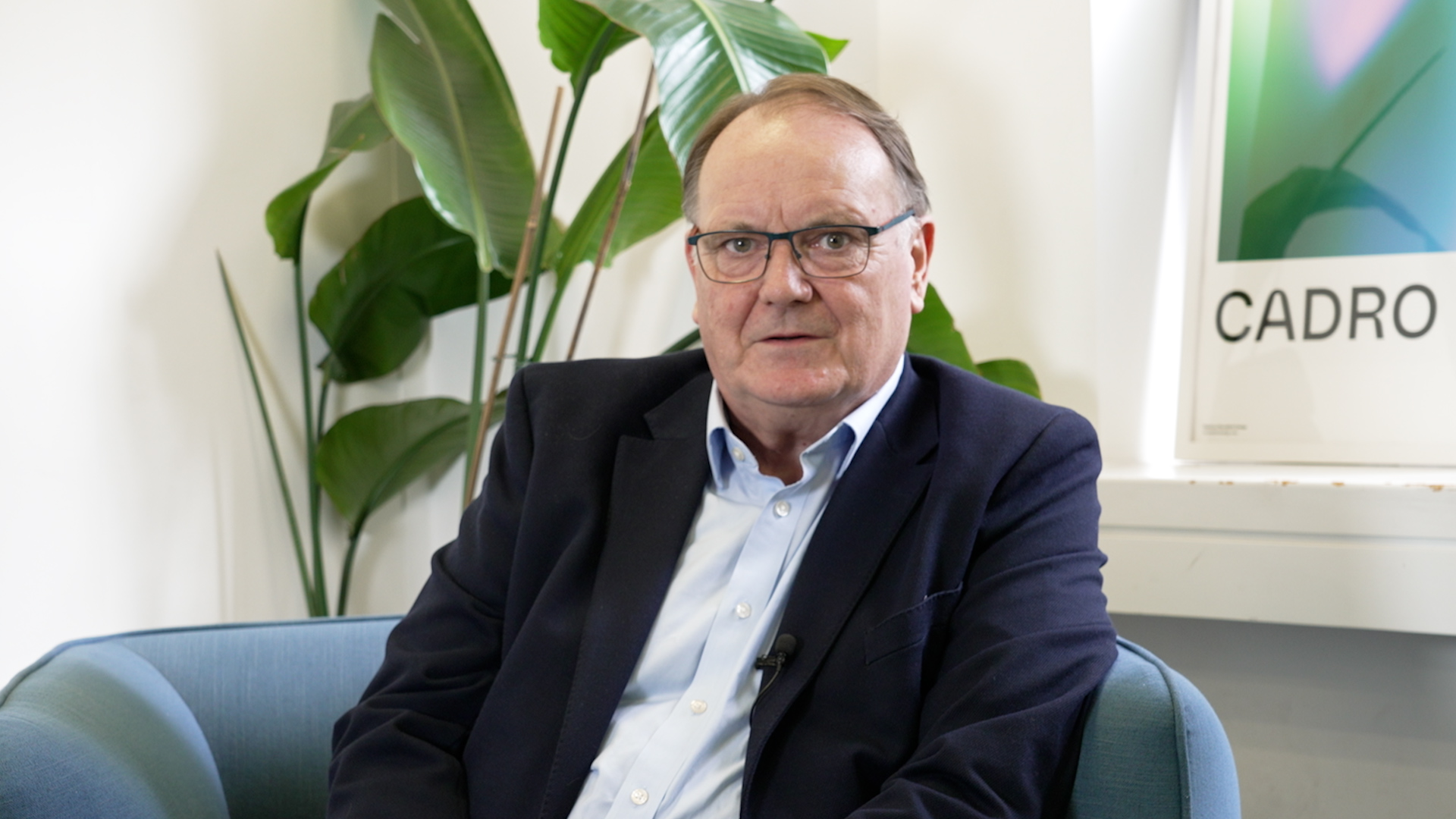
To those in-the-know, Gordon Hurst is a titan of industry.
When he joined the small computer services and professional outsourcing company Capita in 1988, the firm had a team of 45 people and a turnover of £2m per year. Fast-forward 27 years and Gordon was still the Group Chief Financial Officer, but Capita was now operating as a FTSE 100 company, with a staff of around 70,000 and a market cap of about £8Bn.
That remarkable story is part of what makes Gordon so beguiling as a leader – but he didn't stop there. In the years since stepping back from his life at Capita, he's remained a trusted adviser and Chairman to a host of other innovative firms, from financial crime prevention experts Featurespace, to the AI-powered cybersecurity giant Darktrace.
Now the Chairman of Cadro, Gordon discusses his time coming up through the industry, the importance of great people, how he keeps engaged after a lifetime of challenges, and what makes a good business anyway.

Introducing Gordon Hurst, Cadro Chairman
My name: I'm Gordon Hurst, as you know. I'm the chairman of chairman of Cadro.
Prior to that I spent 27 years as the CFO of Capita, or basically the CFO of Capita – taking it from, you know, a very small £2 million business to, when I left, it was about £4.5 billion turnover. Not trying to pretend it was all me, but hopefully I did something along the way that helped.
And now I've got a plural career as a Non Exec Chair of a number of companies. And before Cadro the most noticeable were Darktrace, which I chaired for about three years after its IPO, and also a fraud detecting business called Featurespace.
Getting started at Capita
It was 45 people.
I had an interview with one of the other directors, and I sort of, like, asked him: well, what do you think this could be? So, it was 45 people, so it was turning over £2 million a year.
So, what do you think this could be? He said, well, you know, I reckon we could get this to £20 million quid, £20 million a year.
So, I was sitting there thinking: crikey! I could be financial controller of a £20 million-a-year business. I mean, how brilliant would that be?
Obviously it panned out a little bit differently.
How much do good people matter in business?
Especially at early stage part of the business, if you know each other – boy, doesn't it help.
You know, because you know, each other’s, largely, strengths and weaknesses. If you've got together, it's more likely you're going to trust each other. And that means being open. So if something's bad, you say: this is bad.
Oh, right, what are we going to do about it, then? If something’s good, you go: well, this is really good – right, how do we do more about it? And who made that good? Oh, it was that person over there. Right, fantastic. Let's give them more to do.
Often you’d talk to analysts, when I was at Capita I had to talk to analysts, and they'd say, well, what's the secret sauce? And I'd say, well, it's culture. And they would just not understand anything that I talked about.
You know, they would automatically assume that it's a system. And something that is scalable. And you press a button and it happens.
To make that a reality, to make it all happen is only through people. Nothing else. If you want systems, people get systems.
When I'm looking at a business or hopefully helping in a business, it's not really the numbers. Obviously they're a very important yardstick, but it's what the people are, their level of ambition that they've got, what people they bring around them to create a team. And then, what actions they're doing.
That's what I think is fundamentally important. And the, you know, numbers follow after that.
Adaptability and making yourself redundant
You learn that you've got to be very adaptable, very quickly.
So my job at Capita would change every year. So, how do I think I managed todo that? Because it's not obvious that you can. And not a lot of people can go with the business from 45 people to 60,000.
You know, some people set themselves up, they work very, very hard, but not effectively. And what they're doing is they become a bottleneck for progress. You shouldn't be working until 12:00 every night, you know, not unless it's a real, you know, there's a – I'll call it a deal – or something. You know, something of real significance, something of ground breaking change.
On a routine basis, you shouldn't be working like that. One of my skills at Capita was to make myself redundant. So, then I can do my job. Because if you don't, you’re just stuck there, and you can't progress the company – as I said before, when you become that bottleneck.
From vision to implementation
We didn't like the word “strategy”. I still don’t really like it. I still don't really understand it.
You clearly have to have a vision, you know – a bit more than a mission statement. But virtually a one-side-of-paper mission on, what you think you're going to do, and how you're going to grow, in big picture language.
And then the trick, I believe, is to get very, very quickly into an implementation plan. So you go from vision to implementation and you don't get stuck in the middle of somebody having to think that they've got to write a strategy paper about something. By which time, the opportunity’s gone.
So, that's what I mean by we “didn't do strategy”. We went from vision to implementation very, very quickly. And again, that implementation was often around getting the right team.
The way we did that was, it wasn't sort of like a random process. It was very much about overlapping adjacencies to what we already did, you know. So, in the early days the business was effectively an IT consultancy business, putting in systems for government, particularly local government, to be more efficient.
And then you go, well, actually all these departments within a local authority are using the computer system – why don't we run the administrative functions of some of those? And if we can do it for local authorities, why can't we do it for central government? Why can't we do it for big financial institutions etc? And then, every now and then you look back and you go, crikey: look what we've created.
Dealing with complexity
So initially, you get a bit scared and you think, I don't know what to do here. And then the answer is always: you've got to get somebody in.
That is always the answer. So once you realise that's what the answer is, it makes you tackle problems a lot easier. You know, you've got to be on top of some kind of a plan to make sure, yes, that makes sense. But, fundamentally, as the business grows, fundamentally your role changes to be a team manager.
You know, that's what really you're doing. You know, setting a bit of a direction, setting some objectives. Understanding how people think they can approach that, and then testing to see whether, yeah – that makes sense. Or, I don't know about that.
You know, someone says, well, we can put that system in in two months. You go, well – last time we did anything like that it took at least six months. So, do you really mean that? So you test it, but you don't do it.
So again, it comes back to the recognition of what you need around.
Leaving Capita after 27 years
Do you want to ask me or my wife?
I think it did come naturally, that, hold on, after 27 years – well, maybe after 25 years – you’ve got to go, right, [I’ve got a] couple of years.
Because, you want to do something else, you know. It's weird, although we ran Capita very much like, a private equity vehicle, and it was a private equity – it was backed by 3i, you know.
But then you go round private equity companies when I left Capital and they just thought of me as a Big Company person. And I’m going, well hold on a minute: it is a big company now, but that's because it was a private equity company and it's been one of the most successful ever. Or, certainly at that point in time it was.
So yeah. So it was it was quite easy, actually, to get your head down and go: no, I want to do something else. I want to do something else. I didn't know whether I would be able to, but I did want to do something else.
It was a very weird feeling, getting up, sort of, like on the first Monday after leaving, thinking well, what am I going to do now then? You know, I had got myself one, non-exec Chair role, which was for a fantastic company called Featurespace.
But I didn't play golf. And people say, Oh, well, you can do all your hobbies now, can't you? That's great, fantastic for you, Gordon. Brilliant. Really happy for you. You think, well I haven’t got any hobbies, you know. Because if you work in London in the type of environment we were, and I live out in Reading – so that's an hour and a half/two hours each way. So no, you don't have hobbies.
So, it was a very weird feeling, a very difficult feeling. Because then I realised that, well, what do you actually like doing? Well, actually, what you like doing is working in a team, in a business environment to achieve something and make something better.
That's what gave gives me a buzz. That's what I like doing.
The role of the Chairman
I think there’s sort of like two main parts to it really.
One is a bit of an interface between the investor, or main investor, or investors and the Chief Executive or the Co-founders in this case (for Cadro), with Nataša (Williams) and Jordan (Buck).
That's not necessarily something that sort of, like, needs to be handled every month, or all the time or anything. But sometimes it's useful to have a different path. Sometimes a different path can be useful.
But then the main part for me is helping the team build the business. And how you do that can only be dependent upon, you know, what stage the business is at and what the issues are.
I don't think you can come with a sort of like a pre-formatted way. Sometimes with non-execs that come on a board, where I've experienced it, they want to do something different because they've been used to having reporting in this way, and that way, and that way.
And all it does is create a massive diversion, with zero added value. So, you've got to be very careful not to do things that don't add value.
Some of it is sort of like a confidence thing. You know, it's sort of like saying, no, you know. You're fine. You know, it's not working yet. I know that. But stick at it. Don't change for the sake of it just because it's not working now, if you're doing the right things.
Sometimes, however, obviously you've got to go, well – hold on a minute. We got something, we've got to change something here. And guess what? Guess what? Very often, if not always, it's people.
Finding successful companies
Yeah, I mean my response is going to be uncannily sort of like, consistent.
So it's about the people and it's about the Chief Exec. And it's about, has this person got the ambition, or is their ambition just to take it to, you know, a two-year stage?
And then, off, or whatever. Or if they've got a broader ambition looking, you know, five, ten years out of what this business, can be. And you've obviously got to identify whether it's complete rubbish or not, because you don't want sort of like, just people with fancy dreams, but no realism attached to it.
So, for me, the thing is it's all about structure and people.
And by that I mean the structure, you know, of an organisation needs to change as it grows. So, sometimes in an early stage business somebody will do part of the operations, part of the sales, be a bit of a jack-of-all, really good. But there comes a stage where, hold on – no. We need to have a proper sales person, a proper this, a proper that.
And that person might be one of them. I didn't mean to say they're not one of them. So, that's the structure part of it. And then, obviously the people part is the right people. And the right culture where – and again, culture comes from the top. It doesn't come from anywhere else. But where – the end result of a good culture is where people feel engaged. They feel that they can have an open discussion with their manager, and they are trusted to do stuff as opposed to treated badly or treated like a, you know, a child or whatever.
You can spot, sometimes, bad cultures where the leader goes into bar, and says, well, I want to sit over there. And somebody from the bar, they're doing an interview, or they're doing some spreadsheets and you say, well, someone's using that bit. No, no, I want to go and sit over there.
Even that, you go, right – okay. This person's not right. This person is not right, you know, you do not treat people like that. So, it's about how you treat people to get the best out of them, therefore succeeding as a business asa result of it.
Why work with Cadro?
Again, both Nataša and Jordan have extensive careers within the industry.
So, they clearly know it really well. They know the frustrations that they've had – sometimes, again, about culture within those businesses, and about how that translates into how those organisations treat people. So, it's more about how you engage with them rather than “treating” I suppose, I should say.
And they could see, well, hold on, we want to start treating our clients in a different way which we think – it's not going to suit everybody. But, we think we would like to do. So, I think they had a clear idea of how they want to build a different wealth management business.
So, that, coupled with the clear experience that they've got, and also that's supported by the people that Nataša and Jordan got on the Investment Committee. You know, they're very, very, very senior people. You know, as you say with 40 years’ experience, each of them.
You know, so they've been round the cycle. So I mean, I'm not part of the Investment Committee because I’m not qualified for it. But I sit in on it, on maybe once every other month. Because actually I enjoy it. I like to hear what they're talking about.
And it is a three-hour meeting of a lot of stuff, about what to look out for in various markets. Which mean, do we need to change the investment mix or not.
So sometimes it might be that we want to watch out for something, but we're not going to change yet because there's not quite enough evidence. But then that will come up again the next time or the time after that, and then maybe action and change.
So, the mere fact that Nataša and Jordan have been able to bring with them those really, really senior people, I think is again, testament to not only the people they are, but also the ambitions that they've got for the business.
How do you stay motivated?
It's wanting to do something that adds value.
You know, it always comes down to that. As I say, when I first left Capita and got up that Monday morning thinking: what the heck am I going to do now, then? It was just a horrible feeling. I could fill my day with stuff.
My wife would say: Oh no, you can do that, you can do that, you can do that, do that, to do that. So I could fill my day, but it wouldn't fill my brain. And it wouldn't fill my satisfaction in terms of have I done something useful?
And to me, in this context, useful is – a lot of it is about helping, you know. So, charity could be something, actually, that could fulfil that type of thing. But, you know, I think the place I can help the most is in the environment of a business.
What advice would you give your former self?
I'd say there's two things.
One is believe in yourself. I do think that everybody – and I do mean everybody– has got the capacity (apart from Kevin Pietersen, going back to cricket – sorry about that). Apart from Kevin Pietersen who had a rather large ego, but also [was]a very talented [cricketer].
But everybody, I think, has got the capacity to achieve a lot more than they ever think. So, one is believe in yourself.
And the other thing, and I've read a lot of criticism of this comment thatI'm going to make, but I still believe it. And that is be yourself. Don't try and be something, somebody else. Just because that person over there is doing brilliantly.
You know, you can learn something from other people, absolutely. But don't change it – don’t. Be yourself. Be true to what you are, what your values are.
Learn from other people, but don't try and be them. Because it don't work!